What is an Adjective?
adjective
adjective (noun): a part-of-speech that modifies or describes a noun or a pronoun
An adjective is one of the eight parts of speech.
An adjective is a word that tells us more about a noun. It “describes” or “modifies” a noun (The big dog was hungry). In these examples, the adjective is in bold and the noun that it modifies is in italics.
An adjective often comes BEFORE a noun:
- a green car
- a dark sky
- an interesting story
And sometimes an adjective comes AFTER a verb:
- My car is green.
- The sky became dark.
- His story seemed interesting.
But adjectives can also modify pronouns (She is beautiful). Look at these examples:
- They were empty.
- I thought it seemed strange.
- Those are not expensive.
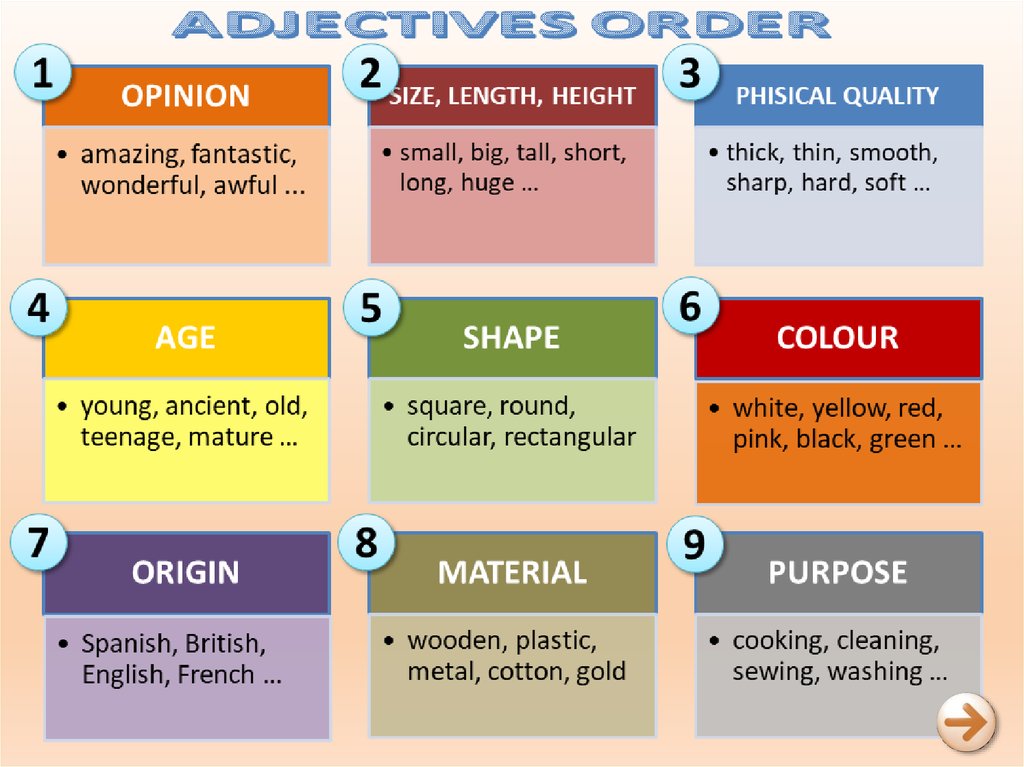
Note that we can often use two or more adjectives together (a beautiful young French lady / it is black and white).
The adjective is the enemy of the noun
This is sometimes said because, very often, if we use the precise noun we don’t need an adjective. For example, instead of saying “a large, impressive house” (2 adjectives + 1 noun) we could simply say “a mansion” (1 noun).
Adjective Form
Some adjectives have particular endings, for example:
- -able/-ible: washable, credible
- -ish/-like: childish, childlike
- -ful/-less: careful, careless
- -ous: dangerous, harmonious
- -y: dirty, pretty
However, many adjectives have no obvious form.
Note:
| Subject | To be | Adjective |
| I He She It You They We | am is is is are are are | tired nervous happy small tall kind hungry |
Ini azmi mem
BalasHapus